Quick answer: Use September and October as a planning window to inspect and repair before Dubai's more rain-prone winter period. Start with drains and safe visual evidence, then identify whether the likely route is roof membrane, balcony, window/seal, bathroom, plumbing or condensation. “Fix before November” is a practical editorial deadline, not an official guarantee about the first rain date.
Waterproofing is not one service. Rain can enter at a roof outlet, parapet, balcony threshold, window joint or façade detail; indoor water can come from plumbing, AC condensate or a wet-area membrane. The visible stain may sit far from the entry point. This hub helps choose the next guide and quote scope without pretending to diagnose an unseen building.
Stop condition: if water is uncontrolled, close to lights or sockets, causing a ceiling to bulge, or accompanied by falling material or structural cracking, keep people away. Use the appropriate emergency and property-management route. Do not puncture a ceiling bulge, climb onto a wet roof or enter a flooded electrical area.
Which waterproofing or leak service do you need?
| Evidence | Likely first route | Do not assume |
|---|---|---|
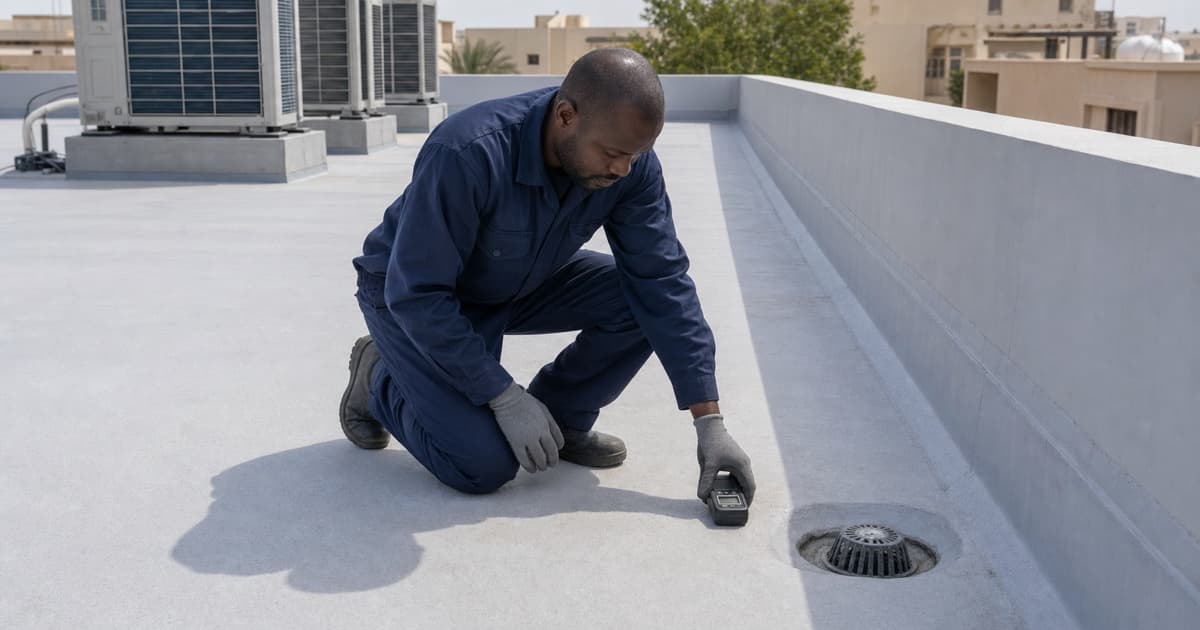
| Top-floor stain after rain; ponding or failed roof detail | Roof waterproofing guide | That a new coating alone fixes slope or drainage |
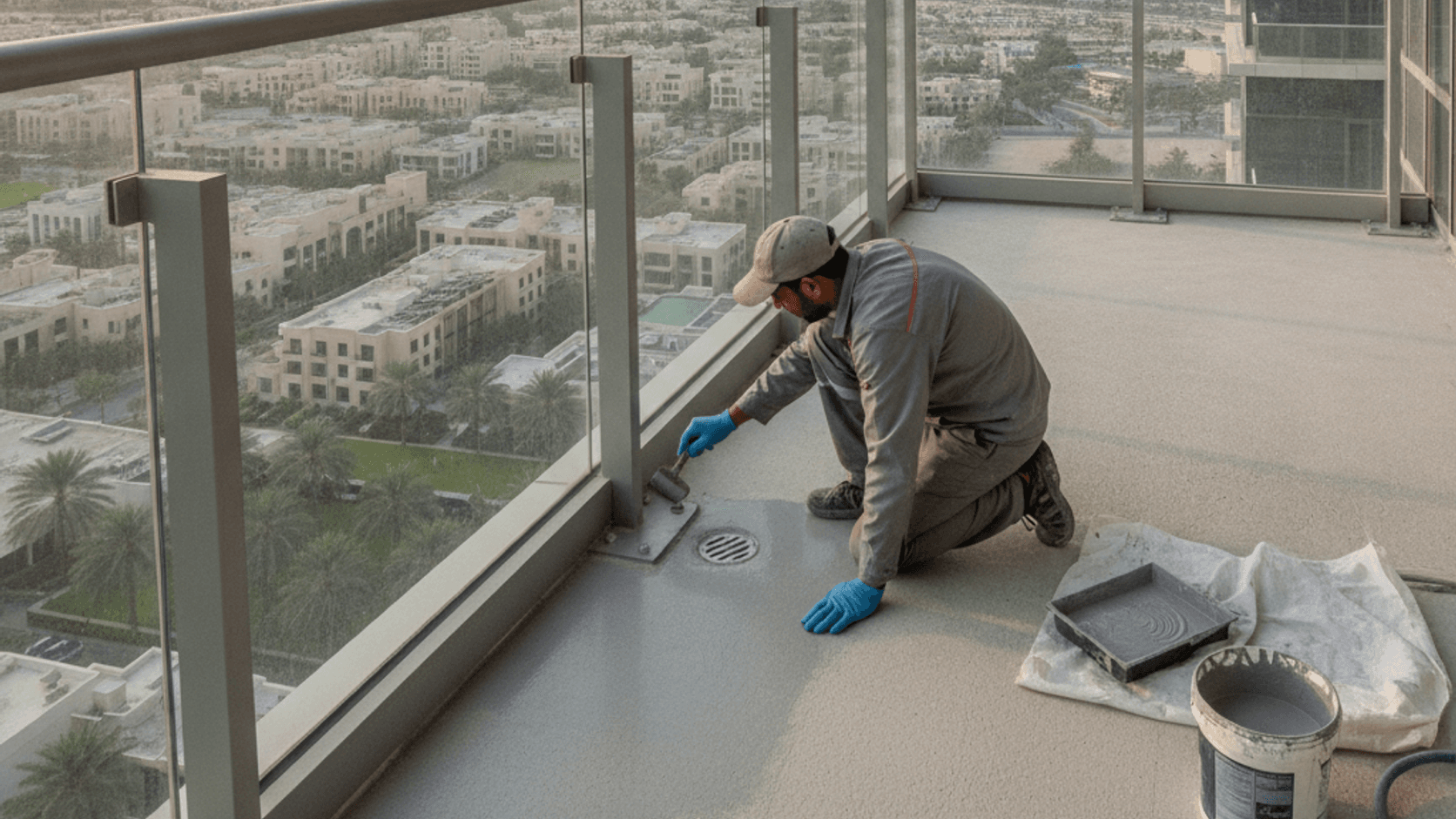
| Water below a balcony after rain or washing | Balcony waterproofing guide | That regrouting repairs the membrane |
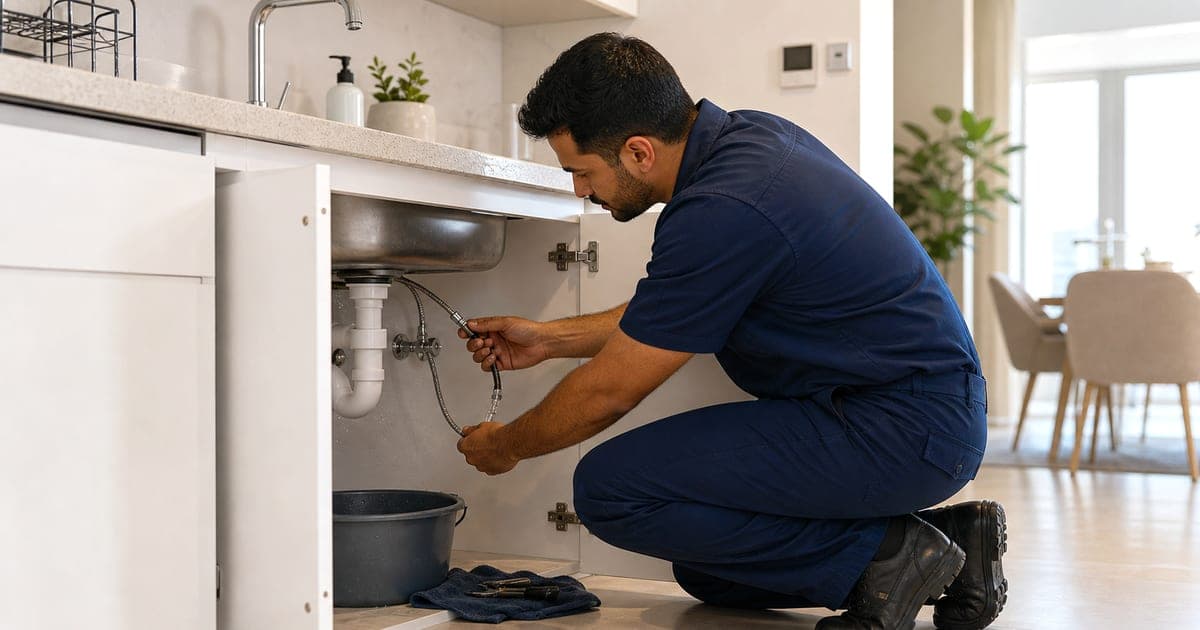
| Leak below a shower or bathroom, independent of rain | Bathroom waterproofing guide or plumbing diagnosis | That the source is waterproofing rather than supply/waste pipework |
| Cracked seal around a window, door or sanitary joint | Silicone caulking guide | That surface silicone fixes a structural or concealed failure |
| Source unclear or water travels between rooms | Leak detection guide | That the nearest visible crack is the source |
| Damp or mold after the leak | Repair and dry the moisture source, then mold remediation if needed | That repainting or fogging alone prevents return |
Ground-level and authorised-access checklist
Owners and tenants should inspect only from safe, permitted locations. Roofs, façades and external glazing need authorised access and suitable safety controls.
- Roof: ask an authorised inspector to record outlets, strainers, ponding marks, parapet upstands, cracks, old patches, penetrations and AC plinth details.
- Balcony: check outlet flow, surface fall, door threshold, tile cracks, perimeter joints and staining below.
- Windows and doors: record failed perimeter sealant, loose gaskets, blocked tracks and whether water appears only with wind-driven rain.
- Ground drainage: clear leaves and ordinary debris from safely accessible private drains; do not open public infrastructure.
- Interior: map stains by room, ceiling/wall position, time, rainfall direction, fixture use and AC operation.
- Service areas: check pump-room, water-heater, AC-drain and tank history so indoor sources are not mislabeled as rain penetration.
Six-week plan before November
| Timing | Action | Output |
|---|---|---|
| 6 weeks before | Collect last-rain photos, plans, warranties and prior invoices | One defect map, not a folder of unexplained close-ups |
| 5 weeks before | Arrange safe inspection and moisture/source diagnosis | Named likely route and areas requiring access |
| 4 weeks before | Request like-for-like repair quotes | Preparation, system, details, tests, cure and warranty |
| 2–3 weeks before | Complete work in a suitable dry-weather window | Batch/material record and before/during/after photos |
| 1 week before | Complete specified testing and drainage check | Signed result and unresolved exceptions |
| After first rain | Inspect the same mapped locations | Performance evidence for any callback |
Do not compress preparation, coats, cure and testing into one promised day unless the specified system and manufacturer data genuinely allow it. Product data varies: substrate dryness, humidity, temperature, recoat time and rain resistance are system-specific.
Why drainage comes before coating
Dubai Municipality's own weather-readiness work emphasises drains, filters, gradient lines and inlets. On private property, the same principle applies at a smaller scale: a membrane cannot compensate indefinitely for a blocked outlet, poor fall or water held against a threshold.
A roof quote should identify ponding, drain count, outlet details, parapets, penetrations, AC bases and any screed repair. A balcony quote should identify outlet capacity, falls, threshold height, perimeter joints, tile removal and reinstatement. If one proposal only says “waterproofing paint,” it is not yet comparable.

Planning costs: route first, price second
| Scope | Indicative Dubai planning context | What the number cannot tell you |
|---|---|---|
| Small roof/terrace patch | Often AED 800–2,500 | Whether the patch addresses the real entry path |
| Common roof membrane system | Often AED 40–90 per sqm | Prep, details, thickness, removal and protection |
| Larger villa roof | Often AED 4,500–15,000+ | Slope, drains, old membrane and access |
| Small defined silicone work | Often AED 150–500 | Whether sealant is appropriate for the failure |
| Multiple or longer sealant runs | Often AED 600–1,500+ | Exterior access, joint design and old material removal |
| Leak detection | Diagnosis-based quote | Repair and reinstatement unless expressly included |
These are indicative planning ranges from existing Bestimate guides, not quotes or transaction averages. Do not add every row together. Choose the route supported by evidence and request the relevant scope.
What a waterproofing quote must specify
| Quote item | Write it clearly | Failure risk if missing |
|---|---|---|
| Diagnosis | Observed defects, moisture evidence and limits of inspection | Treating the visible stain instead of the entry route |
| Preparation | Cleaning, drying, removal, crack/screed repair and primer | New material debonds from a weak or wet substrate |
| System | Manufacturer, product, layers/thickness and reinforcement | Non-equivalent prices look comparable |
| Details | Drains, parapets, thresholds, joints and penetrations | The highest-risk locations remain excluded |
| Weather window | Temperature, humidity, dryness, rain and recoat constraints | Application or cure falls outside product data |
| Testing | Method, duration, limitations and acceptance record | No shared definition of completion |
| Warranty | Term, covered area, maintenance and exclusions | A long headline hides narrow coverage |
| Reinstatement | Tiles, screed, paint, ceilings and disposal | Repair total grows after approval |
For roof-specific comparison, see Roof Waterproofing in Dubai.
Create useful leak evidence
Take one wide photo showing the room or roof location, one medium photo showing the defect in context and one close photo. Add the time, whether it was raining, wind direction if known, how long after rain the mark appeared, whether plumbing or AC was running and whether the stain changed. Mark locations on a simple floor plan.
Keep original files and prior repair records. Do not use a moisture-meter reading as a complete diagnosis; the instrument, substrate, calibration and comparison points matter.
Compare the correct repair route
One evidence pack, separate scopes: compare multiple provider quotes for free by diagnosis, preparation, material system, details, tests, reinstatement and warranty.
Compare roof waterproofing quotes · Compare balcony waterproofing quotes · Compare bathroom waterproofing quotes · Compare leak detection quotes · Compare plumbing quotes · Compare silicone caulking quotes · Compare mold remediation quotes
Frequently asked questions
When should I waterproof a Dubai roof before rain?
September or October is a practical planning window because it allows inspection, comparison, dry-substrate preparation, curing and testing before the more rain-prone winter period. Weather is not guaranteed, so check the actual forecast and product limits.
Can silicone stop rain leakage?
Only where a failed surface joint is truly the entry path and sealant is the correct detail. It cannot repair a failed roof/balcony membrane, plumbing leak, poor slope or structural joint.
Should I flood-test a roof or balcony?
Only under a competent, agreed method that considers drainage, structure, occupied areas and the specified system. The quote should state the test, duration, limitations and responsibility for damage.
Can waterproofing be applied to a damp surface?
Do not generalise. Many systems require a visibly dry or otherwise defined substrate, while preparation and moisture limits vary. Follow the selected manufacturer's current technical data.
Who repairs a stain after waterproofing?
Ask the quote to separate source repair, drying, damaged substrate, mold treatment where needed and paint/ceiling reinstatement. Do not repaint until the moisture source and drying are addressed.
Does every winter leak need full roof replacement?
No. Some defects are local details; others involve widespread membrane or screed failure. Inspection, moisture evidence and repair boundaries should determine patch versus larger replacement.
Reviewed 30 July 2026. “Before November” is a planning deadline, not a weather guarantee. Prices are indicative planning ranges, not quotes. Final scope depends on safe access, diagnosis, substrate, drainage, selected system, cure conditions, testing and approvals.